
Why Technology Transfer Fails Even When the Process Is Documented
A successful transfer requires more than a complete document package. Receiving teams need process intent, tacit knowledge, clear controls, fit-for-purpose equipment, aligned materials, trained operators, and governance that makes unresolved risk visible before execution.
JMC Life Sciences focuses on the space between what the procedure says and what the manufacturing organization must actually understand to perform the process consistently.
Core idea
Documentation is necessary. Translation is what makes execution possible.
JMC Life Sciences
Read the full article
A complete batch record does not mean you have transferred the process.
That distinction matters more than many organizations realize.
When a technology transfer begins, one of the first questions is usually: Do we have the documentation?
The process description is available. The batch record has been drafted. The bill of materials exists. The equipment list is complete. The analytical methods have been identified.
Everything appears ready.
And yet, when the receiving site begins executing the process, problems emerge. Operators interpret instructions differently. Equipment behaves differently than expected. Hold times stretch. Material movement becomes awkward. A seemingly insignificant manipulation suddenly matters. The sending site says, “We’ve never seen that before.”
The problem is not necessarily poor documentation. The problem is that a manufacturing process is larger than the documents that describe it.
The Documentation Illusion
Documentation creates a sense of completeness. A well-written process description can tell someone what happens: add the media, incubate for the specified duration, harvest the cells, perform the wash, transfer the material, collect the sample.
But manufacturing success often depends on details that are much harder to capture. How slowly is the media added? Where is the pipette positioned? How aggressively should a flask be manipulated? What does the culture actually look like when it is ready? How long does a seemingly simple transfer take with the production equipment? What does an experienced operator notice before an excursion occurs?
Those details often live in the experience of the people performing the process. That is tacit knowledge — knowledge that exists within execution but may never have been completely translated into the procedure. During technology transfer, tacit knowledge is one of the first things that can be lost.
Technology Transfer Is Translation
I think about technology transfer less as copying a process and more as translation.
The sending site may understand the process perfectly within its environment. The receiving site may have capable people, qualified equipment, approved materials, and strong quality systems. But the receiving organization still has to translate that process into its own reality.
- Does the process fit the facility?
- Does the equipment produce the same operational outcome?
- Are material flows practical?
- Can operators execute the manipulations consistently?
- Are process ranges understood, or are people simply following target numbers?
- Do analytical methods provide information quickly enough to support manufacturing decisions?
- Have the critical assumptions behind the process actually been transferred?
A successful transfer therefore cannot simply ask, “Did we transfer the documents?” It must ask, “Did we transfer the process knowledge required to reproduce the outcome?”
Training Is Not the Same as Transfer
Another common mistake is treating training as proof that transfer has occurred. An operator can read a procedure, observe a demonstration, and complete a training record. None of those activities necessarily demonstrate that they can execute the process successfully.
This is especially important in complex biologics, cell therapy, gene therapy, and other highly manual manufacturing environments. Small differences in technique can matter. Pipetting technique matters. Mixing matters. Timing matters. Equipment configuration matters. Culture assessment matters. Handling matters. Even the physical layout of the workspace can affect execution.
Training should therefore move beyond procedural familiarity. The receiving team needs opportunities to perform the process, make decisions, encounter variability, receive feedback, and demonstrate repeatability. That is why training runs and engineering runs are so valuable when they are used correctly. They expose what the documentation missed.
Engineering Runs Should Find Problems
Organizations sometimes approach engineering runs as rehearsals that are supposed to succeed. That mindset misses part of their value.
An engineering run should test the process against reality. This is where assumptions collide with people, equipment, materials, facility constraints, sampling requirements, analytical turnaround times, scheduling, documentation, and actual manufacturing behavior.
If an engineering run exposes a weakness, that does not automatically mean the transfer failed. It may mean the engineering run did exactly what it was supposed to do. The real failure is discovering those weaknesses during PPQ, validation, or commercial manufacturing because the earlier runs were treated as demonstrations instead of learning opportunities.
The Process Has to Fit the Facility
A process developed in one environment does not automatically fit another. Something as simple as changing a vessel, tubing configuration, freezer, centrifuge, incubator, biosafety cabinet, or transfer bag can introduce new operational considerations.
The scientific intent may remain unchanged while the execution changes significantly. That is why facility and equipment readiness cannot simply be a qualification exercise. Teams should ask: Can this process actually be executed here the way we believe it can?
Sometimes the answer reveals unexpected issues with ergonomics, capacity, material movement, equipment availability, sampling, storage, or operator workflow. Those details may look operational rather than scientific, but operational details can become process risks very quickly.
Process Knowledge Needs Structure
Strong technology transfer programs deliberately capture knowledge that might otherwise remain informal.
- Normal Operating Range (NOR): Where does the process normally operate?
- Proven Acceptable Range (PAR): Where has the process demonstrated acceptable performance?
- Critical Process Parameters (CPPs): Which parameters have the potential to affect critical quality attributes?
- Critical Material Attributes (CMAs): Which incoming material characteristics influence process performance?
- Process dependencies: What relationships exist between timing, equipment, materials, operators, and downstream outcomes?
Without this structure, the receiving site may know the target but not understand the boundaries. And knowing the target is not the same as understanding the process.
The Transfer Is Complete When the Receiving Site Owns the Process
One of the strongest indicators of technology transfer maturity occurs when the receiving team stops asking, “How did the sending site do this?” and begins confidently explaining, “Here is how this process works in our facility, here are its risks, here are its operating ranges, and here is how we control it.”
That is ownership.
The goal of technology transfer should not be permanent dependence on the sending organization. The receiving site should eventually possess the scientific, operational, and manufacturing understanding necessary to execute, troubleshoot, improve, and defend the process.
Documentation Is the Beginning, Not the Finish Line
Good documentation is essential. But documents are containers for knowledge — they are not the entirety of the knowledge itself.
Technology transfer succeeds when the receiving organization understands not only what to do, but also why it is done, what matters most, what can vary, what cannot vary, what failure looks like, and how to respond when reality does not match the procedure.
That is the difference between transferring a batch record and transferring a manufacturing process. And in advanced biomanufacturing, that difference can determine whether a program merely reaches the manufacturing floor — or is actually ready to manufacture reliably.
JMC Life Sciences LLC helps life sciences organizations bridge the gap between process development and manufacturing execution through technology transfer, MSAT strategy, operational readiness, manufacturing support, and process improvement.
Thought Leadership
Areas of Insight
Technology Transfer
Translating development knowledge into receiving-site capability without mistaking documentation for readiness.
Manufacturing Readiness
What facilities, equipment, materials, documents, training, and governance must look like before critical execution begins.
MSAT & Troubleshooting
Structured approaches to variability, deviations, root cause, CAPA, process performance, and technical decision-making.
Late-Stage Readiness
Preparing organizations for PPQ, inspection, commercialization, and tighter technical discipline as programs mature.
Leadership
Building technical teams that think clearly, communicate across functions, and execute under pressure without defaulting to blame.
Operating Strategy
Connecting technical operations, business realities, capacity, risk, and patient impact into better manufacturing decisions.
Video insights
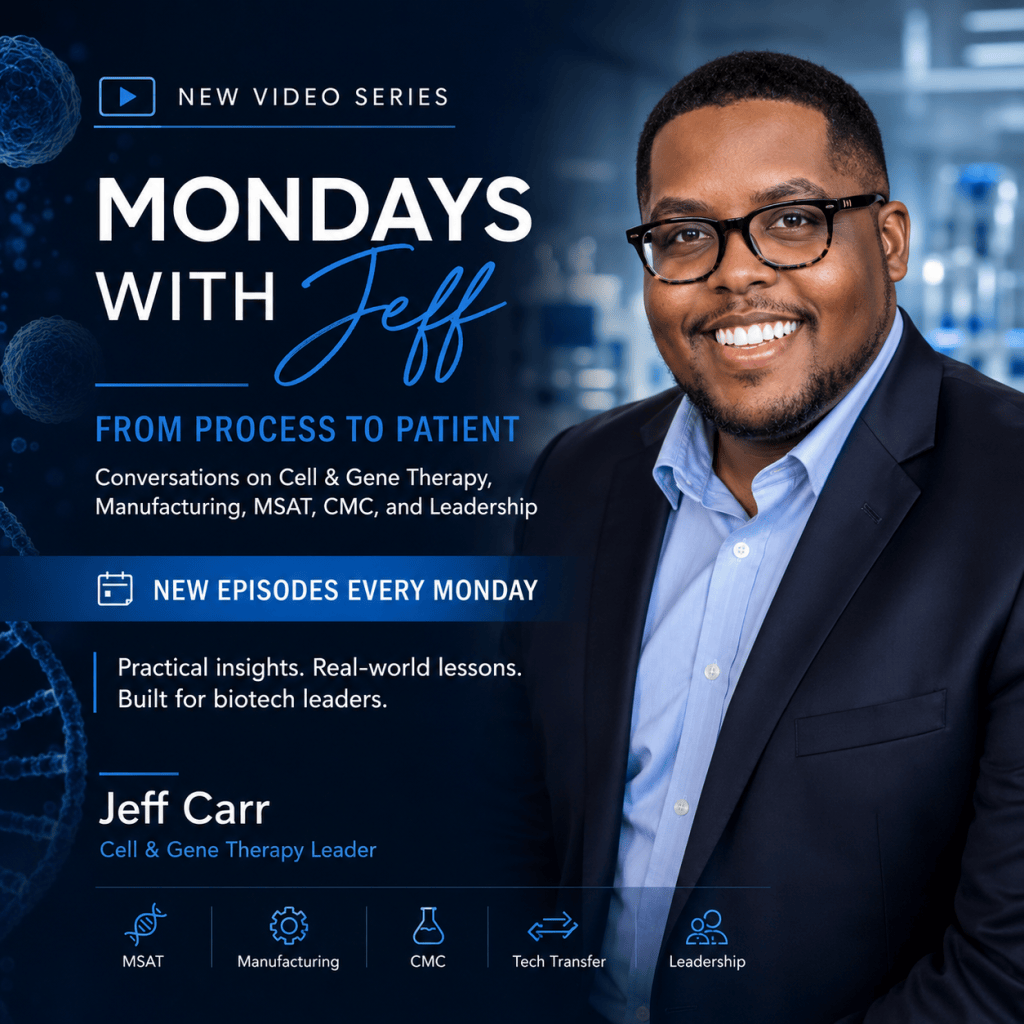
Mondays with Jeff
Short-form thought leadership on manufacturing, MSAT, leadership, operating discipline, and the human side of biotech execution.
The goal is not to make complex work sound simple. It is to make the path forward clear.
JMC Life Sciences
Put the ideas to work
 JMC Life Sciences LLC